
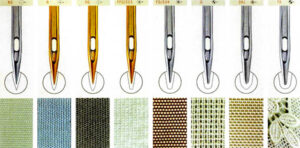
Why the Right Needle Changes Everything
Think of the needle as a translator between your machine and your fabric. When the match is right, the machine glides along quietly and stitches look beautiful. When it’s wrong — even slightly — your machine starts complaining in every way it knows how.
A mismatched or worn needle can cause:
- Skipped stitches (the most common symptom I see)
- Thread breaking mid-seam
- That annoying clicking or knocking sound
- Fabric puckering, stretching, or getting little holes
- Uneven stitches that look fine on top but messy underneath
- In serious cases: damage to the hook — which is an expensive repair
People spend hours adjusting settings, cleaning bobbin cases, and rewinding thread when the real fix would have taken 30 seconds and cost 25 cents.
Every Needle Type Explained (With Honest Recommendations)
This is the section most guides get wrong. They list needle types but don’t tell you why each one exists or what actually happens when you use the wrong one. Let me fix that.
Universal Needle
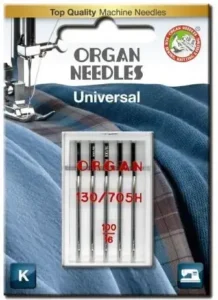
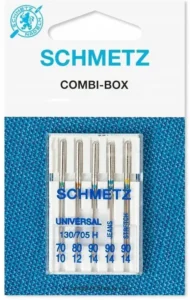
The everyday workhorse. It has a slightly rounded tip — not perfectly sharp, not fully ballpoint — which lets it work on a wide range of woven fabrics.
Best for: Cotton, linen, most woven synthetics, quilting cotton, light canvas Avoid it for: Stretchy fabrics, knits, delicate silk, leather
👉
Schmetz Universal Needles on Amazon |
Organ Universal Needles on Amazon — the pack I keep at my bench at all times.
Jersey / Ballpoint Needle
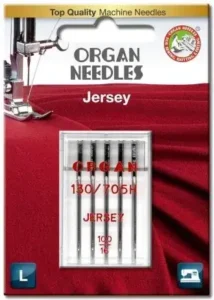
This one has a rounded, ball-shaped tip specifically designed to slide between the loops of knit fabric instead of piercing them. Using a sharp needle on knits is like trying to push through a net with a spike — you’ll snag and break the fibers.
Best for: T-shirt knits, jersey, interlock, sweater knit, bamboo fabric Common mistake: People use Universal needles on knit T-shirts and wonder why the fabric holes don’t close up
👉
Schmetz Jersey Needles on Amazon |
Organ Jersey Needles on Amazon
Stretch Needle
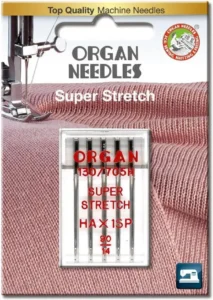 This looks similar to a Jersey needle but has a deeper scarf (the little groove above the eye) that helps the hook catch the thread more reliably on stretchy fabrics. It’s specifically engineered to prevent skipped stitches on high-elasticity materials.
Best for: Lycra, spandex, swimwear, activewear, elastic fabrics Why it matters: Regular needles on spandex will skip every 2–3 stitches no matter what you do to the tension
👉
Schmetz Stretch Needles on Amazon |
Organ Stretch Needles on Amazon
Denim / Jeans Needle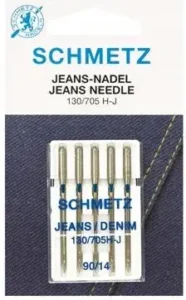
Stiffer, thicker shaft. Very sharp tip. Designed to push through dense woven fibers without deflecting or bending. I’ve seen lightweight needles snap completely when someone tried to sew through double-layer denim.
Best for: Denim, heavy canvas, upholstery fabric, multiple layers of thick cotton Sizes to use: 90/14 for regular denim, 100/16–110/18 for thick jeans or canvas
👉
Schmetz Denim/Jeans Needles on Amazon |
Microtex / Sharp Needle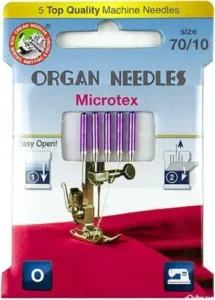
Extremely fine, very sharp tip. Makes the cleanest, most precise stitches possible on tightly woven or slippery fabrics. The “sharp” in the name tells you exactly what it does.
Best for: Silk, taffeta, batiste, microfiber, technical fabrics, faux suede Also great for: Topstitching on quilts where you need a perfectly straight, clean line
👉
Schmetz Microtex Sharp Needles on Amazon |
Organ Microtex Needles on Amazon
Leather Needle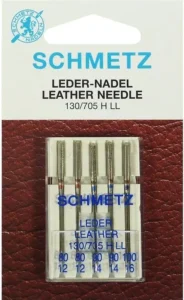
This one’s different from every other needle on this list. It has a wedge-shaped cutting tip — it actually cuts through the material rather than pushing past fibers. That’s what leather and vinyl require, because they don’t stretch or yield.
Best for: Genuine leather, faux leather, vinyl, thick PVC Critical warning: Never use a leather needle on regular fabric. That cutting tip will shred woven fibers immediately.
👉
Schmetz Leather Needles on Amazon |
Organ Leather Needles on Amazon
Quilting Needle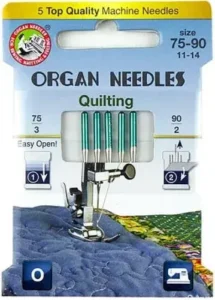
Tapered tip designed to pierce through multiple layers cleanly — fabric, batting, backing — without pushing them out of alignment. It’s slightly stronger than a standard needle to handle all those layers.
Best for: Quilt sandwiches, multiple fabric layers, batting When to use it: Any project with 3+ layers where stitch consistency matters
👉
Schmetz Quilting Needles on Amazon |
Organ Quilting Needles on Amazon
Topstitch Needle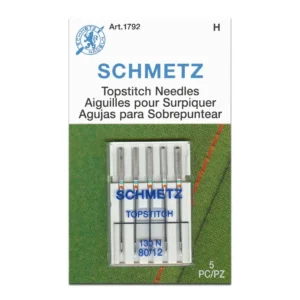
Has an extra-large eye. That’s the whole point — it handles thick decorative threads that would shred trying to squeeze through a standard eye. The groove along the front is also deeper, which helps with thread control.
Best for: Decorative topstitching, heavy thread, double thread in a single needle Common use: Jeans topstitching, visible hems on jackets
👉
Schmetz Topstitch Needles on Amazon |
Organ Topstitch Needles on Amazon
Embroidery / Metallic Needle
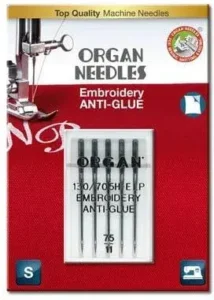
The eye is slightly larger and polished smooth. Embroidery and metallic threads are fragile and prone to shredding — the polished eye reduces friction enough to make them workable.
Best for: Machine embroidery, rayon thread, metallic thread, decorative thread Without it: Your metallic thread will break every 3 inches
👉
Schmetz Embroidery Needles on Amazon |
Organ Embroidery Needles on Amazon
👉 Schmetz Metallic Needles on Amazon |
Organ Metallic Needles on Amazon
Twin Needle
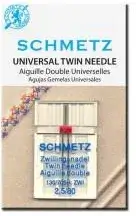
Two needles on a single shank. Creates two parallel rows of stitching on top with a zigzag underneath — which gives that professional stretch hem you see on store-bought T-shirts. Your machine needs to support twin needles (check your manual — most do).
Best for: Knit hems, pintucks, decorative parallel lines Sizes: The number before the slash is the distance between needles (e.g., 2.0/80 = 2mm apart, size 80)
👉
Pingback: Why Does My Sewing Machine Needle Keep Breaking ? - sewingsage.studio