About the mechanic

I never planned to become a mechanic. Today it’s what I know best.

I’m Alex. I’ve been fixing sewing machines for 20 years: in a garment factory, in my own repair shop, and now here.

20 yearsin the trade
Engineerelectromechanical
Own shopin Poland
Alex working on a sewing machine at his bench under a desk lamp
Alex · SewingSage
Bench log

How I got here

2003Chapter 1

A choice I didn’t plan

I grew up in a small village by the Neman river. After school, I failed my entrance exams to the technical university in Minsk. My godfather said: “Go to college and study sewing machine mechanics. You’ll be fine.” I applied at the last minute, sat in the back row, and was sure it was temporary.

In 2006 I graduated as a mechanical technician. But I wasn’t a real mechanic yet. Passing an exam is one thing. Being alone with a machine that won’t sew is something else entirely.
2006Chapter 2

The factory

My real training started at a children’s clothing factory: about 150 machines and two mechanics per shift.

They put me on nights. At night, nobody stands over your shoulder. If a machine won’t sew, you sit down next to it and figure it out. One hour, two hours, as long as it takes. The machine beside it is the same model, so you compare the two and look for the difference.

Later they moved me to the day shift so someone could keep an eye on me. It felt almost like a punishment. A month later, the day-shift seamstresses wouldn’t let me go back.

The designers worked during the day. Every six months there was a new collection, and a seamstress would come to me and say: “I need this exact stitch.” I had to choose the machine, the needle, the thread, the tension, the presser foot pressure, then test it all on that fabric. The next day the fabric was heavier, and I set it all up again.

What I learned
“A mechanic is the person who makes a machine work the way the job needs it to.”

Mechanics have a saying: the better the mechanic, the more he sits around. When everything sews, nobody notices his work.

2013Chapter 3

The degree I finished after all

While working, I enrolled in the distance-learning program at the same university whose exams I had once failed. In 2013 I graduated as an electromechanical engineer. Later I completed advanced training on Brother computerized sewing machines.

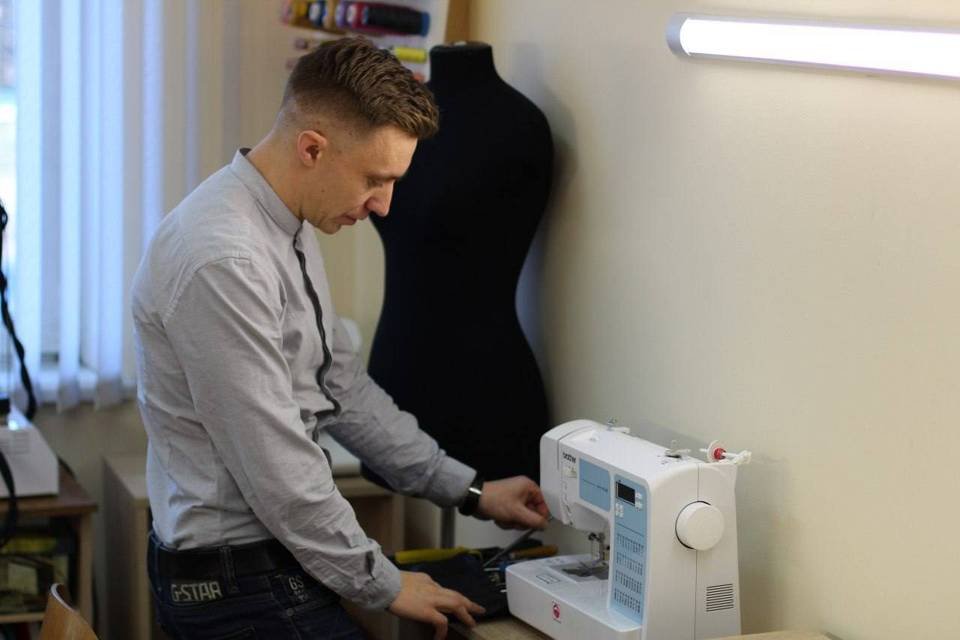
Alex checking a computerized sewing machine in the workshop
LaterChapter 4

On my own

On my days off, I started taking private jobs: an ad in the newspaper, a drive to the customer’s house. Then word of mouth kicked in. Seamstresses moved to other factories and called me in there too.

Soon I left the factory and went out on my own, working with factories, tailoring studios, and home machines.

Alex smiling at a table with two overlockers and a sewing machine
2020Chapter 5

Poland

In 2020 I moved to Poland with my family. Today I have my own repair shop here. People send me machines from all over Poland, and sometimes from neighboring countries, when shipping makes sense.

Alex working on a vintage sewing machine in his workshop, an industrial machine by the window
Today
Why SewingSage

Most of it isn’t a repair at all

Over the years I’ve seen how huge the demand for repair is. And how often nobody ever explained how the mechanism works and what to do with it.

A lot of things you can do yourself. Once you understand your machine, you need a mechanic far less often.

I can’t get to every machine in the world. So I write down here what I check first: in plain language, with photos, step by step. That way you can decide for yourself what you can handle, and when it’s better to take the machine to a pro.

Cover of The Complete Clean, Oil and Service Guide
Free guide

Start with a proper clean

The Clean, Oil & Service Guide. Step by step, with photos from my bench.

Get the free guide