Sewing Machine Needles: The Complete Guide

From a Mechanic Who's Seen It All

sewing machine needles

You changed the thread. You rethreaded. You adjusted tension. It still skips stitches.

Here’s what most sewers never suspect: the needle.

It’s the cheapest part in your machine — a good 5-pack costs around $5. But a worn or wrong needle causes more skipped stitches, torn fabric, and unnecessary repair bills than almost anything else. People replace it last, if ever.

From a mechanic’s perspective: swapping a needle costs next to nothing. Ignoring it can cost you a new hook assembly or a full timing adjustment — and that’s a very different bill.

I’ve seen it hundreds of times. Someone brings in a machine that “suddenly stopped working right.” They’ve rethreaded six times, adjusted tension, cleaned the bobbin. The real culprit? A needle that should have been changed three projects ago — and looked perfectly fine.

Stick with me and you’ll stop troubleshooting the wrong thing. I’ll cover every needle type, what fabric it works with, which brands are worth buying, and what those numbers on the package actually mean.

Why the Right Needle Changes Everything
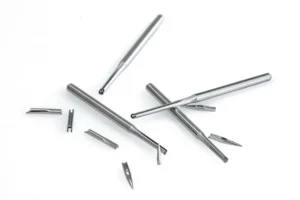
Think of the needle as a translator between your machine and your fabric. When the match is right, the machine glides along quietly and stitches look beautiful. When it’s wrong — even slightly — your machine starts complaining in every way it knows how.

A mismatched or worn needle can cause:

  • Skipped stitches (the most common symptom I see)
  • Thread breaking mid-seam
  • That annoying clicking or knocking sound
  • Fabric puckering, stretching, or getting little holes
  • Uneven stitches that look fine on top but messy underneath
  • In serious cases: damage to the hook — which is an expensive repair

People spend hours adjusting settings, cleaning bobbin cases, and rewinding thread when the real fix would have taken 30 seconds and cost 25 cents.

Understanding Needle Sizes and Markings

What “130/705 H” Actually Means

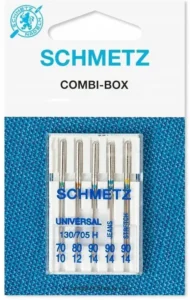
If you’ve ever looked closely at a pack of home sewing machine needles, you’ve seen 130/705 H printed on it. This is the universal standard for all modern domestic machines — Singer, Brother, Janome, Juki (domestic), Bernette, Baby Lock, Elna, Pfaff home models, Kenmore — basically everything you’d have in a home studio.

  • 130 = the needle length (in fractions of a millimeter, standardized)
  • 705 = the flat shank style — one flat side so it can only go in one way
  • H = Haushalts-Nähmaschinen, German for “household sewing machine”

You don’t need to memorize what each number means. What matters: if your machine is a home sewing machine, you need 130/705 H needles. Full stop.

Needle Size Numbers: The European/American System

After 130/705 H, you’ll see a size like 80/12 or 90/14.

  • The first number (80, 90, 100…) is the European metric size
  • The second (12, 14, 16…) is the American size
  • Bigger number = thicker needle

Here’s the practical translation:

Needle SizeFabric Weight
60/8 – 70/10Very thin, delicate (chiffon, organza, tulle)
75/11 – 80/12Light to medium (cotton, linen, quilting fabric)
90/14Medium to medium-heavy (light denim, fleece, canvas)
100/16 – 110/18Heavy (thick denim, upholstery, multiple layers)
120/20Very heavy industrial weight

When in doubt, start with an 90/12 Universal needle. If something looks off — the stitch skips, the fabric puckers — that’s your machine telling you to try a different needle size or type.

Every Needle Type Explained (With Honest Recommendations)

This is the section most guides get wrong. They list needle types but don’t tell you why each one exists or what actually happens when you use the wrong one. Let me fix that.

Universal Needle
Close-up of sewing machine needle size markings 80/12 and 90/14 on packaging Different types of sewing machine needles laid out on a white background with labels

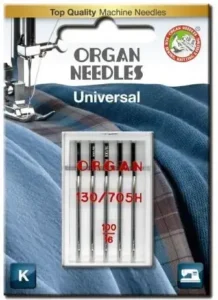
The everyday workhorse. It has a slightly rounded tip — not perfectly sharp, not fully ballpoint — which lets it work on a wide range of woven fabrics.

Best for: Cotton, linen, most woven synthetics, quilting cotton, light canvas Avoid it for: Stretchy fabrics, knits, delicate silk, leather

👉

Schmetz Universal Needles on Amazon |

Organ Universal Needles on Amazon — the pack I keep at my bench at all times.


Jersey / Ballpoint Needle
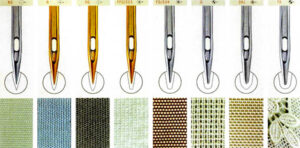
Comparison of universal, ballpoint, and stretch sewing machine needle tips under magnification

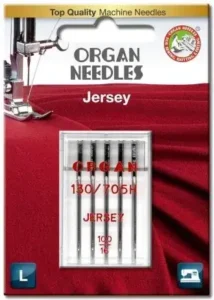
This one has a rounded, ball-shaped tip specifically designed to slide between the loops of knit fabric instead of piercing them. Using a sharp needle on knits is like trying to push through a net with a spike — you’ll snag and break the fibers.

Best for: T-shirt knits, jersey, interlock, sweater knit, bamboo fabric Common mistake: People use Universal needles on knit T-shirts and wonder why the fabric holes don’t close up

👉

Schmetz Jersey Needles on Amazon |

Organ Jersey Needles on Amazon

Stretch Needle
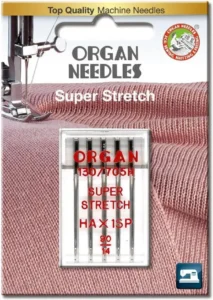
Sewing machine needle inserted incorrectly causing skipped stitches on knit fabricThis looks similar to a Jersey needle but has a deeper scarf (the little groove above the eye) that helps the hook catch the thread more reliably on stretchy fabrics. It’s specifically engineered to prevent skipped stitches on high-elasticity materials.

Best for: Lycra, spandex, swimwear, activewear, elastic fabrics Why it matters: Regular needles on spandex will skip every 2–3 stitches no matter what you do to the tension

👉

Schmetz Stretch Needles on Amazon |

Organ Stretch Needles on Amazon


Denim / Jeans NeedleSchmetz and Organ sewing machine needle packages on a wooden workbench
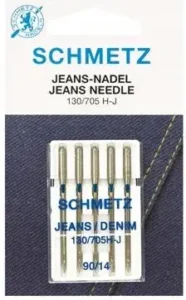
Stiffer, thicker shaft. Very sharp tip. Designed to push through dense woven fibers without deflecting or bending. I’ve seen lightweight needles snap completely when someone tried to sew through double-layer denim.

Best for: Denim, heavy canvas, upholstery fabric, multiple layers of thick cotton Sizes to use: 90/14 for regular denim, 100/16–110/18 for thick jeans or canvas

👉

Schmetz Denim/Jeans Needles on Amazon |

Organ Denim Needles on Amazon


Microtex / Sharp NeedleChart showing sewing needle types and matching fabric weights for home sewists

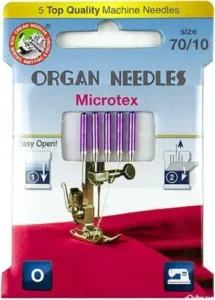
Extremely fine, very sharp tip. Makes the cleanest, most precise stitches possible on tightly woven or slippery fabrics. The “sharp” in the name tells you exactly what it does.

Best for: Silk, taffeta, batiste, microfiber, technical fabrics, faux suede Also great for: Topstitching on quilts where you need a perfectly straight, clean line

👉

Schmetz Microtex Sharp Needles on Amazon |

Organ Microtex Needles on Amazon


Leather NeedleLeather sewing machine needle with wedge-shaped tip next to faux leather fabric
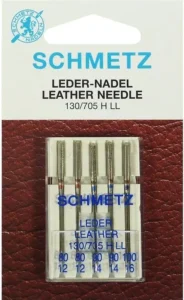
This one’s different from every other needle on this list. It has a wedge-shaped cutting tip — it actually cuts through the material rather than pushing past fibers. That’s what leather and vinyl require, because they don’t stretch or yield.

Best for: Genuine leather, faux leather, vinyl, thick PVC Critical warning: Never use a leather needle on regular fabric. That cutting tip will shred woven fibers immediately.

👉

Schmetz Leather Needles on Amazon |

Organ Leather Needles on Amazon


Quilting NeedleDenim needle versus universal needle side by side showing tip and shaft thickness difference
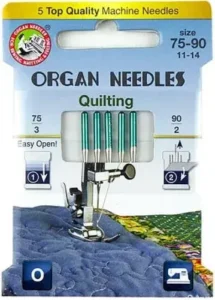
Tapered tip designed to pierce through multiple layers cleanly — fabric, batting, backing — without pushing them out of alignment. It’s slightly stronger than a standard needle to handle all those layers.

Best for: Quilt sandwiches, multiple fabric layers, batting When to use it: Any project with 3+ layers where stitch consistency matters

👉

Schmetz Quilting Needles on Amazon |

Organ Quilting Needles on Amazon


Topstitch NeedleHand replacing a sewing machine needle — flat side of shank facing back of machine
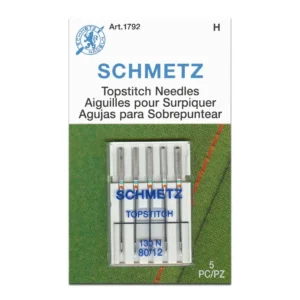
Has an extra-large eye. That’s the whole point — it handles thick decorative threads that would shred trying to squeeze through a standard eye. The groove along the front is also deeper, which helps with thread control.

Best for: Decorative topstitching, heavy thread, double thread in a single needle Common use: Jeans topstitching, visible hems on jackets

👉

Schmetz Topstitch Needles on Amazon |

Organ Topstitch Needles on Amazon


Embroidery / Metallic Needle
Worn and bent sewing machine needle next to a new needle showing visible tip damage

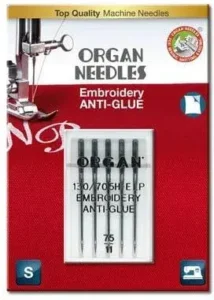
The eye is slightly larger and polished smooth. Embroidery and metallic threads are fragile and prone to shredding — the polished eye reduces friction enough to make them workable.

Best for: Machine embroidery, rayon thread, metallic thread, decorative thread Without it: Your metallic thread will break every 3 inches

👉

Schmetz Embroidery Needles on Amazon |

Organ Embroidery Needles on Amazon

👉 Schmetz Metallic Needles on Amazon |

Organ Metallic Needles on Amazon


Twin Needle
 Sewing Machine Needles: The Complete Guide

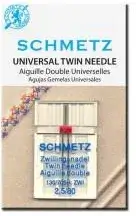
Two needles on a single shank. Creates two parallel rows of stitching on top with a zigzag underneath — which gives that professional stretch hem you see on store-bought T-shirts. Your machine needs to support twin needles (check your manual — most do).

Best for: Knit hems, pintucks, decorative parallel lines Sizes: The number before the slash is the distance between needles (e.g., 2.0/80 = 2mm apart, size 80)

👉
Schmetz Twin Needles on Amazon |

Organ Twin Needles on Amazon

This is an affiliate link at no extra cost to you. I earn a small commission if you purchase through this link, which helps me keep creating helpful content.
As an Amazon Associate, I earn from qualifying purchases.

The Big Needle Comparison Table

Needle TypeTip ShapeBest FabricsWatch Out For
UniversalSlightly roundedCotton, linen, most wovensNot for knits or leather
Jersey / BallpointRounded ballT-shirt knits, jersey, interlockDon’t use on wovens
StretchMedium ballpoint + deep scarfSpandex, lycra, swimwearNot needed for low-stretch knits
Denim / JeansVery sharp, sturdyDenim, canvas, upholsteryUse correct size — too thin will snap
Microtex / SharpUltra sharpSilk, taffeta, microfiberCan snag knits
LeatherWedge/cutting tipReal leather, vinyl, faux leatherWill shred regular fabric
QuiltingTaperedMultiple layers, battingOverkill for single-layer sewing
TopstitchSharp, large eyeDecorative thick threadLarge eye can cause issues with fine thread
EmbroiderySlightly large polished eyeRayon, embroidery threadNot needed for standard thread
MetallicLarge polished eyeMetallic threadOnly when using metallic thread
TwinTwo needles, one shankKnit hems, pintucksRequires machine compatibility

The Brands I Actually Trust

I want to be straight with you here: needle quality matters more than most people realize.

In my shop, I constantly see machines that “suddenly started skipping stitches right after I changed the needle.” And almost every time, they switched to a cheap no-name pack from a bargain bin or an unknown seller online.

Cheap needles are made from softer metal. The eye may be rough instead of polished. The shaft can be slightly bent before you even use it. That roughness and inconsistency damages thread, snags fabric, and — worst case — can score the hook timing surface. That’s when a 50-cent needle turns into a $100 repair.

The two brands I recommend to every customer:

  • 🇩🇪 Schmetz — Made in Germany. The industry standard for home machines. Consistent quality, wide variety, available everywhere.
  • 🇯🇵 Organ — Made in Japan. Outstanding for embroidery machines, sergers, and stretchy fabrics. The brand most commercial shops use.

For most sewers, Schmetz is all you need. If you do a lot of embroidery or serging, Organ is worth trying — especially for metallic and rayon threads.

Now, if you’re the kind of person who wants to truly understand how their machine works — not just which needle to use, but things go wrong and how to fix them before they become expensive — I wrote a guide for exactly that. Sewing Needles & Threads: The Complete Reference Guide for Home Sewists covers the 20% of knowledge that prevents 80% of repairs. It’s practical, jargon-free, and written the same way I explain things to a customer sitting right in front of me. If needles, tension, and timing have ever confused you — that’s the book.

Get the guide here →

Disclosure: Links above are affiliate links. At no extra cost to you, I may earn a small commission if you purchase through them. As an Amazon Associate, I earn from qualifying purchases.

When to Change Your Needle (Most People Wait Too Long)

This is probably the most under-followed advice in sewing. A needle doesn’t need to visibly bend or snap before it’s done. The metal tip wears down at a microscopic level, and once it does, it starts doing tiny damage to your fabric and thread with every stitch.

Change your needle when:

  • The machine starts clicking or making a faint knocking sound
  • Stitches become inconsistent or skip randomly
  • Thread breaks repeatedly for no obvious reason
  • You hit a pin (even at low speed — this can create a tiny burr immediately)
  • You’re switching to a significantly different fabric type
  • You’ve been sewing for several hours straight

General rule of thumb: Every 8 hours of active sewing, or after every major project.

I know it feels wasteful when the needle still looks fine. But consider this: a 5-pack of Schmetz needles costs around $5. A hook replacement from skipping-stitch damage costs 10–20x that. The math makes the decision easy.

How to Insert the Needle Correctly Every Time

Since we’re covering the basics: a surprisingly common cause of problems is the needle being inserted incorrectly.

On virtually all home sewing machines:

  1. The flat side of the shank faces the back
  2. Push the needle all the way up into the clamp — as far as it will go
  3. Tighten the clamp screw firmly — not fingertight, actually firm
  4. Give the needle a light tug downward before sewing — if it moves, tighten more

If the needle isn’t fully seated, it will sit too low, miss the hook’s timing, and skip stitches constantly — no matter what brand, type, or size you use.

The Bottom Line

Your sewing machine needle is the cheapest, easiest variable in the whole system — and the one people change last instead of first.

Get in the habit of matching your needle to your fabric, swapping it out regularly, and buying from a brand that actually makes needles with consistent quality. You’ll have fewer tension problems, less thread breakage, quieter operation, and stitches that look the way they’re supposed to.

And if you want to go further — understand your machine at a deeper level, catch problems early, and never get surprised by a breakdown — my Kindle guide Sewing Needles & Threads: The Complete Reference Guide for Home Sewists is where I’d point you next. Every chapter is built around what I see go wrong in real machines, written so that anyone — even someone who’s never opened a bobbin case — can follow along and actually fix things themselves.


About the Author

Alex is a sewing machine mechanic with over 20 years of hands-on experience servicing both domestic and industrial machines. He spent five years working as a mechanic on a sewing factory floor before building his own repair and equipment business. Through his website SewingSage.studio, Alex shares honest, practical advice rooted in real workshop experience — helping everyday sewers understand, maintain, and get more out of their machines without unnecessary trips to the repair shop.

Keep Learning & Fix Your Sewing Machine Faster

If you found this guide helpful, don’t stop here. Most sewing machine problems are easier to fix when you understand how your machine really works.

Check out these helpful guides:

👉 Explore more articles on the blog and learn how to fix your sewing machine like a pro.

And if you prefer video tutorials, subscribe to my YouTube channel where I show real repairs, common mistakes, and practical solutions step by step.

Want to fix your sewing machine like a pro? My book “Basic Guide to Sewing Machine Repair: How to Prevent and Fix 80% of Common Breakdowns” shows you step-by-step how to prevent and repair common issues.

Get it on Amazon

This is an affiliate link at no extra cost to you. I earn a small commission if you purchase through this link, which helps me keep creating helpful content.
As an Amazon Associate, I earn from qualifying purchases.

1 thought on “Sewing Machine Needles: Complete Guide by a Mechanic”

  1. Pingback: Why Does My Sewing Machine Needle Keep Breaking ? - sewingsage.studio

Leave a Comment

Your email address will not be published. Required fields are marked *