1. Worn or Wrong Needle (Most Common Cause)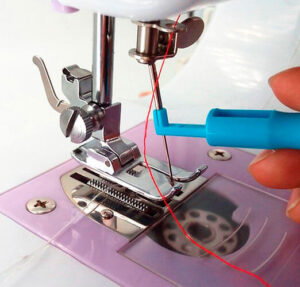
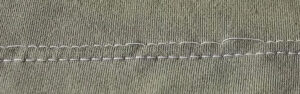
This is the number one reason for skipped stitches.
The needle may be:
- slightly bent
- dull
- incorrectly installed
- wrong type for the fabric
Even a slightly bent needle changes how the loop forms. The hook can’t catch it — and stitches get skipped.
Fix: Replace the needle. Always start here.
2. Needle and Thread Don’t Match
Thick thread in a thin needle is a classic mistake. The loop becomes unstable and the hook misses it.
Simple rule:
- thicker thread → larger needle
- fine fabric → smaller needle and thread
Correct pairing makes a big difference.
3. Low-Quality Thread
Cheap thread is often fuzzy, uneven, or poorly twisted. That leads to inconsistent loop formation and skipped stitches.
In practice, switching to better thread often solves the problem immediately.
4. Damaged Needle Plate
If the needle has hit the plate, the hole may become enlarged or rough. The fabric gets pulled down and the loop forms incorrectly.
Signs:
- fabric pulls into the plate
- skipping on lightweight fabrics
- inconsistent stitching
Fix: Replace the needle plate.
5. Wrong Settings for the Fabric
Switching from thick to thin fabric (or vice versa) without adjusting the setup can cause skipping.
For example:
- knits require different needles
- heavy fabric needs stronger penetration
- delicate fabric needs finer setup
Always test on a scrap before sewing.
6. Worn or Damaged Hook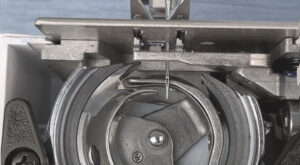
If the hook tip is worn, chipped, or has burrs, it can’t properly catch the thread loop.
Signs:
- skipping on all fabrics
- occasional thread breaks
- inconsistent stitch formation
This usually requires inspection.
7. Needle Installed Incorrectly
If the needle is rotated wrong or not pushed all the way up, the hook timing relative to the needle changes.
This is more common than people think.
Fix:
- loosen screw
- push needle fully up
- align flat side correctly
- tighten securely
8. Needle Type Not Suitable for Fabric
Using a universal needle on stretch fabric often causes skipping. The needle can’t properly form a loop in elastic material.
Examples:
- stretch fabric → use ballpoint needle
- denim → use denim needle
- leather → use leather needle
Correct needle type stabilizes stitch formation.
9. Needle-to-Hook Timing Is Off (Mechanical Cause)
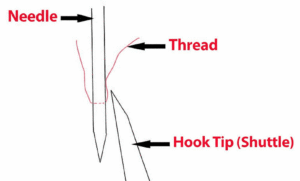
This is a mechanical issue.
It happens when:
- the needle bar shifts vertically
- the needle rises too early or too late
- the hook arrives too early or too late
- the gap between needle and hook changes
Normally, the hook tip must pass very close to the needle exactly when the loop forms. If timing is off, the hook simply misses the loop — and stitches get skipped.
This can happen after:
- hitting something hard
- sewing very thick material
- wear over time
- improper adjustment
This situation requires professional adjustment.
 Quick 5-Minute Checklist
Before assuming the machine is broken:
- Replace the needle
- Match needle and thread
- Try better quality thread
- Check needle installation
- Test on scrap fabric
In most cases, this fixes the issue.
When You Should See a Technician
You likely need adjustment if:
- skipping continues with a new needle
- skipping happens on all fabrics
- machine skips mostly on zigzag
- needle occasionally hits the hook
- you hear metallic clicking
These are signs of timing issues.
Bottom Line
Skipped stitches don’t always mean your sewing machine is broken. Most often it’s a needle, thread, or setup issue. Start with the basics — it saves time and money.
But if the problem is mechanical, continuing to sew can make it worse. Proper adjustment restores correct stitch formation and prevents further wear.
A correctly tuned sewing machine should stitch smoothly, consistently, and without gaps.
Keep Learning & Fix Your Sewing Machine Faster
If you found this guide helpful, don’t stop here. Most sewing machine problems are easier to fix when you understand how your machine really works.
Check out these helpful guides:
👉 Explore more articles on the blog and learn how to fix your sewing machine like a pro.
And if you prefer video tutorials, subscribe to my YouTube channel where I show real repairs, common mistakes, and practical solutions step by step.